B2B tyres are tyres bought and sold between businesses rather than sold to drivers. That covers a distributor supplying a tyre shop, a wholesaler supplying local garages, a commercial depot selling to fleet customers on account, and a fleet buying tyres for its own vehicles. If you run a tyre business, almost everything you buy is B2B, and a growing share of what you sell probably is too.
This guide explains how trade tyre buying works in the UK, what makes up the price you actually pay, and how tyre businesses keep buying and selling under control without living on the phone to suppliers.
What are B2B tyres?
In the tyre trade, B2B simply means business to business. B2B tyres are sold at trade prices through trade accounts, usually on credit terms, with delivery to the business rather than collection by the public. The tyres themselves are the same as those sold to drivers. What changes is the way they are priced, ordered, paid for and delivered.
A typical UK supply chain looks like this:
- Manufacturers produce the tyres and supply distributors, large wholesalers and some direct trade accounts.
- Distributors and wholesalers hold stock in regional warehouses and deliver to tyre shops and garages, sometimes more than once a day.
- Tyre shops, garages and commercial depots fit the tyres for drivers and fleets, and some also sell tyres on to smaller trade customers.
- Fleets buy tyres and fitting either directly or through a tyre management company that looks after their vehicles.
Most tyre businesses sit in the middle of that chain, buying from one or more suppliers and selling to a mix of retail, trade and account customers.
How do you buy wholesale tyres?
To buy wholesale tyres in the UK, you normally open a trade account with a distributor or wholesaler. That usually means:
- Providing company details, VAT number and trading address
- Passing a credit check if you want to pay on account rather than up front
- Agreeing payment terms, often monthly
- Agreeing delivery arrangements, such as cut-off times for same-day or next-day runs
Once the account is open, you order by phone, through the supplier’s website or trade portal, or through a system that connects to the supplier’s stock. Each supplier may have its own login, its own price list and its own way of showing what is in stock, which is where much of the day-to-day admin in a tyre business comes from.
Where can tyre businesses buy tyres in bulk?
Tyre businesses can buy tyres in bulk from four main types of source:
- National distributors, which hold wide ranges across car, van, truck and specialist tyres and deliver frequently
- Regional wholesalers, which often compete on service, delivery times and local relationships
- Manufacturer programmes, which may offer direct supply, marketing support or rebates in return for volume or range commitments
- Other tyre businesses, such as a larger depot or a partner in your network with surplus stock in the sizes you need
Most shops use more than one source. A main supplier covers everyday sizes, while others fill gaps, cover specialist sizes or offer better prices on certain ranges. The challenge is comparing them quickly when a customer is waiting at the counter.
How do you find the cheapest wholesale tyre suppliers in the UK?
The cheapest wholesale tyre supplier is not always the one with the lowest unit price. To compare suppliers fairly, look at the landed cost of each tyre, which includes:
- The unit price on your account, which may differ from the general wholesale list
- Delivery charges, especially on small or urgent orders
- Rebates or retrospective discounts paid against volume
- Payment terms, since longer credit can be worth as much as a small discount
- Stock availability, because a cheaper tyre that arrives tomorrow may lose you today’s job
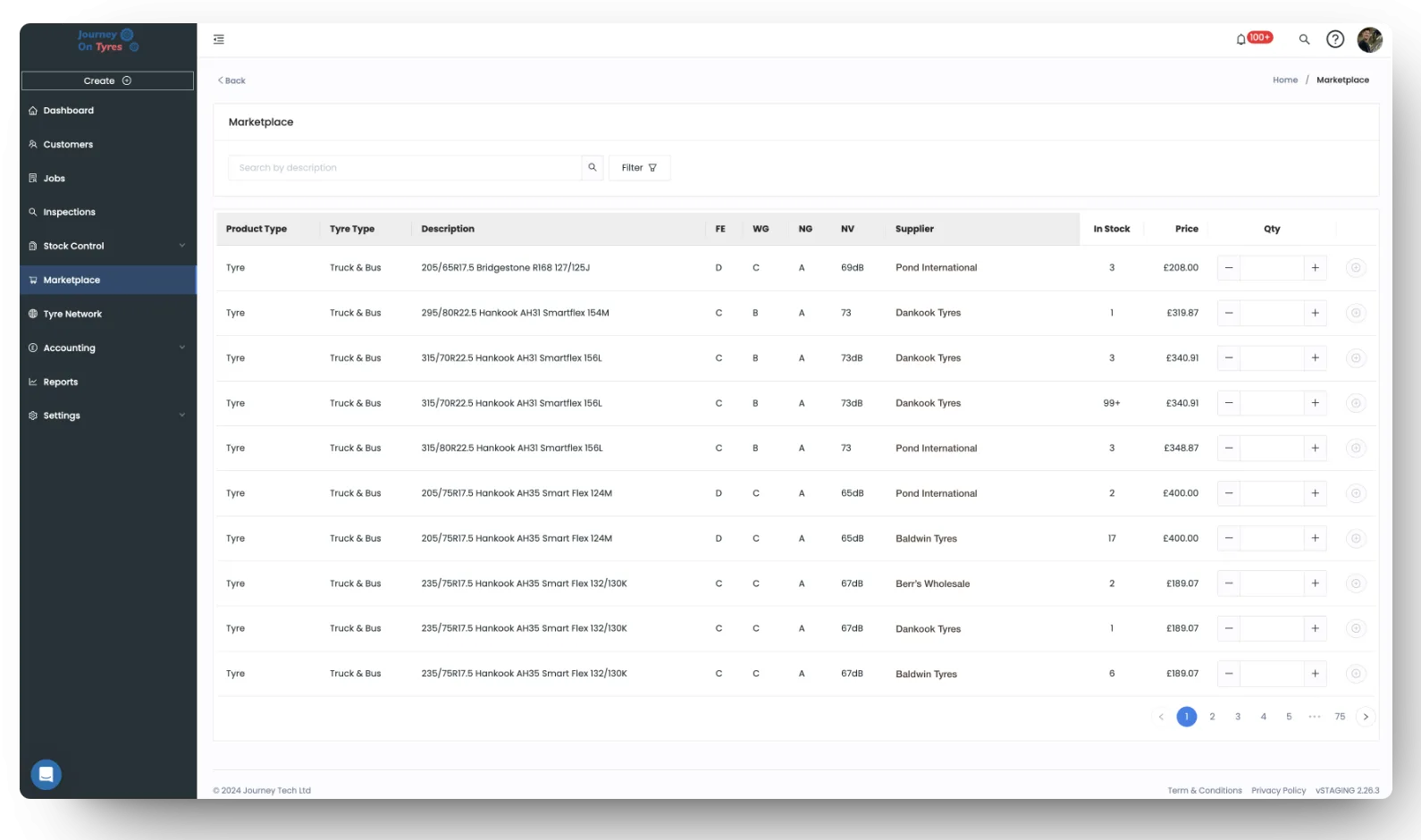
The quickest way to compare is to see every supplier’s stock and price for the same size side by side. On the TyreOps B2B Marketplace, you search once by tyre size or description and see each connected supplier’s stock level and price on a single list, along with EU tyre label ratings for fuel efficiency, wet grip and noise.
How trade tyre pricing works
Price lists by customer segment
Suppliers rarely have one price for everyone. A supplier may set a general wholesale price list for all trade customers and separate lists for larger accounts. When you order through a connected system, the price you see should be the price agreed for your account, not the general rate.
The same applies when you sell. If you supply garages or fleets, you will want different prices for retail customers, trade accounts and contract customers. TyreOps supports five price list types for retail, trade and account pricing.
Credit limits and trade accounts
Trade accounts let customers buy now and pay later, usually monthly. That is convenient, but every account needs a credit limit and someone keeping an eye on it. If you sell B2B tyres yourself, you need to see each customer’s balance before you accept another order.
On the buying side, your own credit limit with each supplier matters just as much. If your main supplier account is close to its limit at the end of the month, orders can be held until a payment clears, which is the last thing you want on a busy Friday. Keeping an eye on your spend with each supplier, and spreading orders sensibly, avoids being caught short when a fleet customer needs a set of drive tyres the same day.
Rebates and manufacturer credits
Rebates and casing credits can make a real difference to margin, but they are easy to lose track of. Casings returned to a manufacturer or collector may earn a credit, and volume rebates may be paid months after the tyres were sold. Keeping these linked to the original purchases makes it much easier to check you have received what you are owed.
Selling B2B tyres to your own trade customers
Many tyre businesses do not just buy B2B tyres; they sell them. A commercial depot might supply smaller garages, a wholesaler might supply a network of independent fitters, and a tyre management company might sell tyres and fitting to fleet operators.
Selling B2B brings its own admin:
- Separate price lists for different trade customers
- Orders coming in by phone, email and text at all hours
- Checking stock before confirming each order
- Raising invoices and tracking payment against credit terms
- Showing your margin on each order before it goes out
The tyre wholesale software side of TyreOps handles trade accounts, dynamic price lists and order processing in the same system as stock and invoicing, so the person taking the order can see the stock and the margin before confirming it.
Managing B2B tyre buying and selling in one platform
Buying from several suppliers usually means several logins, several price lists and a lot of copying between screens. The TyreOps B2B tyre marketplace brings that into one place:
- One search shows stock and price from every connected supplier
- Suppliers keep stock current with daily stock files or a live API connection
- You set the quantity and place the order without leaving TyreOps
- Each order goes into your pending stock purchases automatically, so nothing is re-keyed when the tyres arrive
- Invoices can be created straight from marketplace transactions
- The Marketplace is included on every TyreOps plan
Because each order is recorded as a pending stock purchase the moment you place it, goods-in can be checked against it and nothing has to be typed in twice. If you also run a network of service partners, the Tyre Network lets you buy wholesale tyres from partners through the same Marketplace.
We first introduced the Marketplace in our post on how TyreOps launched its B2B sales marketplace. This guide is the practical side: how trade buying works and what to check before you place an order.
What to check before placing a B2B tyre order
Price is only one part of a good order. Before confirming, it is worth running through a short checklist, especially when the tyres are for a customer who is waiting:
- Size, load index and speed rating match the vehicle, not just the tyre that came off
- The tyre is the right type for the job, such as summer, all-season or a specific commercial pattern for steer, drive or trailer positions
- EU tyre label ratings suit what the customer asked for, whether that is lower noise or better wet grip
- The supplier’s stock is genuinely available for the delivery run you need
- The price shown is your account price, including any delivery charge
- The order will land in your stock records so goods-in can be checked against it
Age is worth a mention too. Every tyre carries a DOT code showing the week and year it was made. Most suppliers rotate stock well, but checking the date code on arrival is a sensible habit, particularly on slower-moving specialist sizes.
For commercial work the stakes are higher. Fitting the wrong pattern on a steer axle, or a tyre with the wrong load index on a trailer, can lead to a roadside failure or a failed inspection. Building these checks into your ordering routine protects both the customer and your reputation.
Common mistakes in trade tyre buying
Even well-run tyre businesses lose margin through small habits in how they buy. The most common are:
- Buying from whichever supplier answers the phone first rather than comparing
- Not checking that the invoice matches the agreed account price
- Over-ordering popular sizes because stock records are out of date
- Forgetting to return casings or claim credits
- Keeping supplier orders separate from stock records, so goods-in becomes a guessing game
Each of these is easier to avoid when your supplier orders, stock and invoices sit in the same system.
Frequently asked questions
What does B2B mean in the tyre trade?
B2B means business to business. In the tyre trade it refers to tyres and services sold between businesses, such as a distributor supplying a tyre shop or a depot supplying a fleet, usually at trade prices and on account rather than to the public.
Who can buy trade tyres?
Trade tyres are generally sold to businesses with a trade account, such as tyre shops, garages, motor dealers and fleet operators. Suppliers normally ask for company and VAT details, and may carry out a credit check before offering payment terms.
Making trade buying simpler
B2B tyres are the backbone of every tyre business, but buying and selling them often runs on phone calls, emails and separate supplier logins. Comparing suppliers on landed cost, keeping prices tied to each account and making sure every order lands in your stock records will protect your margin far more than chasing the lowest unit price. To see how the TyreOps Marketplace works with your suppliers, take a look at the B2B tyre marketplace or book a demo.
TyreOps Team
Content Team at TyreOps
Sharing practical insights on tyre business management, technology and industry best practices.